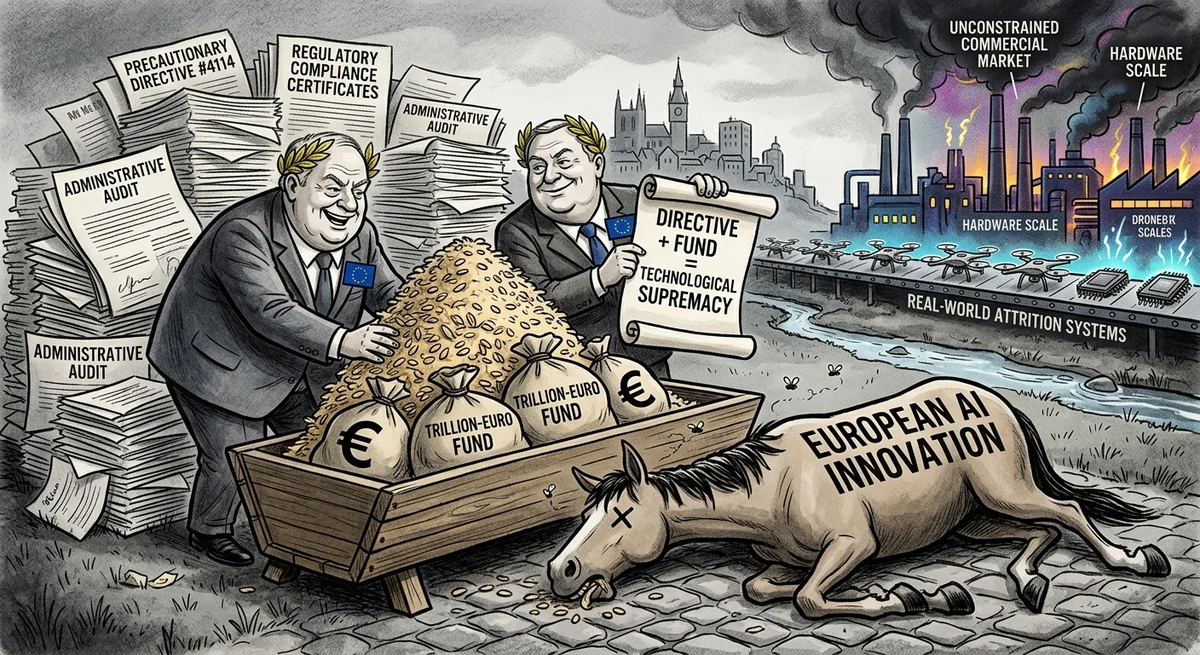
It has recently come to my attention that the administrative mind of Western Europe has achieved a remarkable new state of intellectual equilibrium. This state is characterized by an unflinching belief in the magical properties of legal drafts and public subsidies, coupled with a total, pristine ignorance of computational mechanics and industrial reality.
The central dogma of the European administrative class regarding capital is as straightforward as it is delusional. Capital is treated not as a measure of productive capacity, dynamic risk, or operational velocity, but as a species of sacred fuel. To the bureaucrat, capital is an abstract numerical quantity that, when poured into a sufficiently large trough marked "Innovation Strategy," automatically yields the desired social and technological outcomes.
The mental model operates on a breathtakingly naive assumption:
Directive + Trillion-Euro Fund => Technological Supremacy
In this whimsical worldview, state-allocated capital behaves like an obedient servant. The European leadership imagines that by drafting thousands of pages of precautionary directives, establishing audit boards, and earmarking vast sums of public debt, they have successfully commissioned the construction of an artificial intelligence base. They believe that when an aggressive foreign adversary presents a tangible hardware threat, the European Union need only point to its pristine balance sheet and regulatory compliance certificates to command the physical universe into submission.
The actual mechanics of the real world, however, are governed by operational feedback loops, not parliamentary votes.
In reality, capital is merely a signaling mechanism—a fluid medium through which real-world resources, engineering talent, and industrial infrastructure are dynamicized. When capital is injected into a system that has been systematically sterilized by compliance overhead, high energy costs, and an explicit hostility toward commercial scale, its purchasing power degrades rapidly toward zero.
In the case of artificial intelligence, modern systems are a direct, emergent byproduct of the massive, unconstrained civilian consumer market. Generative models and autonomous software do not exist because a committee decreed them; they exist because hundreds of millions of people carry devices that generate vast training corpora, and because commercial markets finance the exponential hardware scale required to process that data.
When the European state over-regulates this civilian substrate, it kills the organic engine of innovation. It then attempts to compensate by throwing public funds at state-approved defense contractors, academic consortiums, and bureaucratic "tech hubs."
This brings us to the fundamental physics of the situation, which can be stated with elementary clarity: you cannot feed a dead horse to make it move your cargo.
A dead horse remains immobile regardless of the monetary value of the oats piled beside its carcass. Doubling the budget does not restore neuromuscular function. It merely results in a more expensive pile of rotting tissue and a very costly, highly audited stable.
A state-managed defense fund cannot conjure native semiconductor foundries, low-cost precision manufacturing, or millions of hours of real-world edge-deployment data out of thin air. When an adversary leveraging a high-volume, unconstrained commercial industrial base deploys millions of cheap, AI-driven attrition systems, a continent choked by its own rulebook will find that its trillion-euro balance sheet cannot intercept a single hardware payload.
The European leadership has not built a fortress of ethical technology. They have merely constructed an elaborate, extraordinarily expensive administrative apparatus designed to manage their own technological irrelevance, right up to the moment the physical universe forces a reality check upon them.