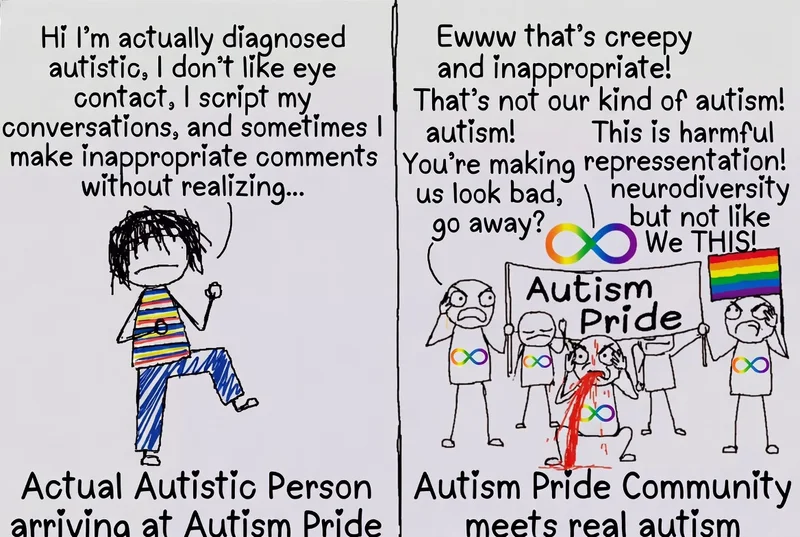
It is a curious characteristic of our highly enlightened age that whenever a complex, difficult problem requires rigorous thought, patient care, or biological precision, we promptly abandon the science and turn it into a theater of political self-aggrandizement.
We have observed, with a mixture of amusement and horror, the recent migration of autism from the sterile pages of clinical neurology to the vibrant, hyper-reactive feeds of social media. What was once a highly heritable, often devastating developmental disorder—defined by precise genetic architectures and severe cognitive deficits—has been swiftly rehabilitated into a highly fashionable lifestyle accessory.
The mechanism of this transformation is as simple as it is intellectually bankrupt. By the grace of the DSM-5, which flattened a highly nuanced spectrum of distinct neurological conditions into a single, generic bucket, the path was cleared for the ultimate democratization of disability. Overnight, the clinical reality of profound neurological impairment was replaced by a highly curated aesthetic. To be "autistic" in the modern parlor is no longer to suffer from a debilitating inability to process sensory input or navigate basic human interaction; it is to have a pleasingly quirky preference for neat rooms, a highly articulate collection of vintage keycaps, and a TikTok account.
This grand demedicalization project is presented, naturally, under the banner of "liberation." We are told by a chorus of highly verbal, self-diagnosed activists that autism is not a medical tragedy to be treated, but a proud, oppressed identity to be celebrated. The "social model of disability" has been elevated to an article of faith: the autistic brain is not impaired; it is merely "different," and any struggle it experiences is entirely the fault of a capitalist, neurotypical society that refuses to accommodate its unique brilliance.
This is a remarkably convenient theory for those whose "autism" conveniently manifests as nothing more than an abrasive personality and a demand for infinite social leniency. It is, however, an unmitigated catastrophe for those with actual, severe neurological deficits.
The exquisite hypocrisy of this modern "neurodiversity" movement lies in its ruthless social gatekeeping. For all their loud, performative demands for "inclusion," "safety," and "radical empathy," these activist circles are among the most viciously conformist environments on Earth. They have created a highly complex, unwritten code of progressive etiquette—a dense web of social cues, linguistic shibboleths, and emotional performances.
And who, pray tell, is the first to be exiled from this utopia of tolerance?
It is, of course, the individual with actual Asperger's Disorder. The person who lacks the neurological hardware for interpersonal empathy, who cannot read the room, who speaks in flat, monotonous monologues, and who routinely misses the highly sensitive social cues of the activist class. In the cold, practical reality of the progressive clique, the genuine clinical deficit of social blindness is not accommodated; it is moralized. The awkward, unpolished, and genuinely impaired individual who "doesn't get clues" is instantly diagnosed not as autistic, but as a "creep," a "boundary violator," or a "bad actor" who threatens the "safety of the space."
The message of the modern autism pride movement is loud, clear, and dripping with contempt: "You are entirely welcome to join our revolutionary struggle, provided you are highly articulate, physically attractive, politically compliant, and don't actually exhibit any of those annoying, creepy symptoms that make you hard to be around."
While these comfortable activists spend their afternoons drafting colorful infographics linking neurodiversity to global geopolitical conflicts, the actual work of human survival is left to the silent, exhausted class of parents, specialized nurses, and clinicians. For a profoundly autistic adult who is non-verbal, self-injurious, and incontinent, there is no "social model" that makes life easy. A political march does not teach a mute child how to feed himself.
But the activist class has no time for such mundane, un-aesthetic miseries. Indeed, they actively campaign to restrict access to behavioral therapies and specialized care facilities, labeling them "oppressive institutions," while offering absolutely nothing in their place except the vague promise of "community acceptance." They demand the destruction of the medical framework that secures insurance, state funding, and legal accommodations for the disabled, apparently oblivious to the fact that the state does not hand out stipends for a "fashionable cognitive style."
We are left with a grotesque spectacle. A movement that claims to fight for the marginalized has successfully colonized a medical diagnosis, scrubbed it of its difficult, unappealing realities, and used it to build a trendy social club. They have climbed onto the backs of the truly disabled to claim the moral high ground of victimhood, and in doing so, they have stomped the very people they claim to represent directly into the dirt.