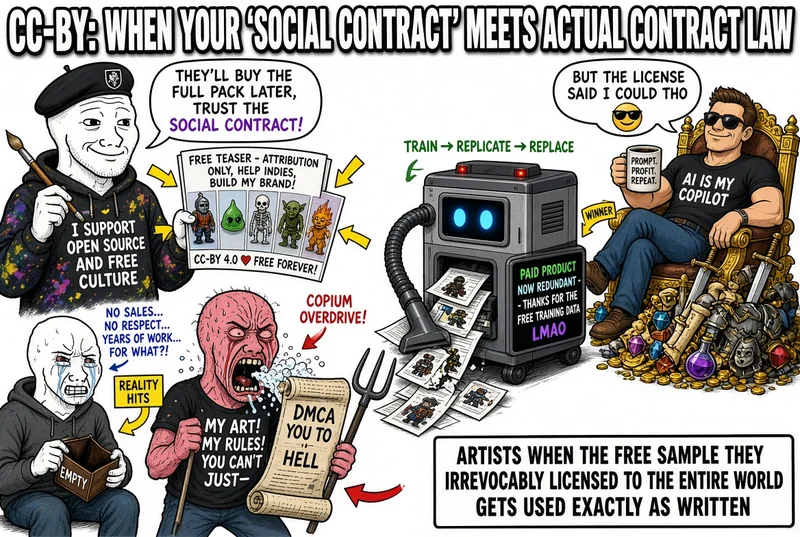
Once upon a time in the magical kingdom of Indie Art, a noble creator would sprinkle their free CC-BY assets across the internet like a benevolent fairy godmother. “Here, peasants!” they declared. “Take my free sample, attribute me, and if you like the taste, buy the full feast!” This was the unspoken social contract, a sacred handshake between generous spirit and grateful consumer.
Then the machines arrived.
Suddenly those same free samples got fed into an AI that spat out a complete sprite pack in the artist’s own style, rendering the paid product about as necessary as a horse-drawn carriage in 2026. Cue the righteous fury. The artist who literally signed a legally binding document granting the entire planet an irrevocable, royalty-free right to copy, modify, and commercially exploit the work now threatens to “DMCA you to hell.” The same hand that clicked “CC-BY” is now shaking a fist and screaming about emotional ownership and “my style.”
Let’s be crystal clear: under the actual law they voluntarily accepted, they are wrong. Dead wrong. A proper attribution satisfies the license. Their DMCA is a false claim. Their moral outrage is the equivalent of selling your car, then showing up at the buyer’s house demanding it back because they drove it somewhere you didn’t emotionally approve of.
But no, the real crime is that the free teaser worked too well. The “sample” did exactly what open licenses are designed to do—spread, get remixed, get used—and the artist is shocked that an automated tool treated the freebie as free. Their intended social contract was never “do whatever the license says.” It was “use my free stuff only in the exact way that still funnels money into my Patreon.” When the universe fails to honor that secret clause, the only remaining weapons are social media pile-ons, platform-abusing takedown notices, and the eternal cry of the betrayed creator: “But I didn’t mean for you to actually use the rights I gave you!”
This is why CC-BY assets have become radioactive landmines. You can follow the license to the letter and still get nuked by a bad-faith DMCA from someone who never read their own terms. The indie community will circle the wagons around the artist’s feelings while treating the person who obeyed the written contract like a cartoon villain. And the root cause remains the same: artists who want the prestige of “open” without the consequences keep picking the wrong license, then act betrayed when the legal document they signed does what legal documents do.
In the end, the open license becomes a trap of pure hypocrisy. Artists feel robbed by the very generosity they advertised, and anyone who actually exercises the permissions they were explicitly given gets treated like a thief. The real lesson? If you don’t want people to use your free stuff for free, stop labeling it free. Put “All Rights Reserved” on the sample and sell the rest. Or keep the CC-BY and accept that “free for any purpose” means free for any purpose—including the purpose of making your paid pack obsolete. Anything else is just performance art for the terminally entitled.